
“The great uncertainty of all data in war is because all action is, to a certain extent, planned in a mere twilight – like the effect of a fog – giving things exaggerated dimensions and unnatural appearance”
Carl von Clausewitz, On War
With the current fragile ceasefire in the Gulf between the US and Iran still holding, global equity markets have been given some respite from the turmoil of the first month of intense military action. However, both the situation today and the path to any sort of return to normality in the Gulf remains far from clear. The fact that 6 weeks and counting of either zero or very low shipment levels passing through the Straits of Hormuz will soon result in physical shortages of unknown degree and duration is difficult for the equity markets to price, although we believe this has been done more successfully in the Japanese market than elsewhere.
All of this brings to mind the concept of the ‘fog of war’ developed by the Napoleonic general sometimes called the philosopher of war, Carl von Clausewitz. Although he seldom used the term precisely in this form, the idea of ‘fog’ or ‘twilight’ denoting the profound uncertainty that emanates out from war and clouds the ability of all participants to accurately assess the landscape and act rationally seems to capture the situation as it exists today both with regard to the status of the ceasefire and the looming supply shortages and how severe or short-term these may prove to be.
SMDAM’s view
- Although the Middle East situation remains highly uncertain, the Nikkei 225 and TOPIX have been trading firmly over the past week.
- Factors behind this include still strong fundamentals across much of the Japanese market, as well as rising U.S. equities, a pause in the oil-price rally, expectations for an agreement in negotiations, and market views that the ceasefire deadline may be extended.
- If an end-to-hostilities scenario is being priced in to some extent, the key to whether Japanese equities can sustain their gains will be the upcoming Japanese and U.S. corporate earnings results and investor reaction to these.
- Whether or not it is premature at this stage to price in the peaceful conclusion of the conflict we cannot say. However, we would point out that where fundamentals have not yet deteriorated, as they haven’t for most of the Japanese market, this seems to be an acceptable approach to the current uncertainty.
Reasons to be cheerful – corporate Japan’s
fundamentals remain strong
Going slightly deeper into why Japanese equities have remained firm despite the ongoing uncertainty and Japan’s well-documented reliance on imported natural resources, we would draw attention to the following factors:
1) Major U.S. equity indices—including the Nasdaq Composite, the Philadelphia Semiconductor Index (SOX), and the S&P 500—have all been hitting fresh record highs day after day, led by gains in tech stocks. This optimism can appear to be incongruous with the events taking place in the Gulf, but the resumption of investor enthusiasm for the AI trade after a period of more muted engagement is understandable. This positive sentiment has fed through into the Japanese market where numerous AI-related stocks can be found, especially those crucial to the hardware and infrastructure layer of the new AI ecosystem.
2) Crude oil prices appear to be losing upward momentum and stabilizing, albeit at a higher level than that seen before the conflict began. This has provided some useful respite for heavy oil-importing economies like Japan, although the long-term vulnerability this conflict has highlighted remains as a structural problem in need of an eventual solution.
3) Finally, the global equity markets evidently still hope and expect that the US–Iran talks aimed at ending hostilities will ultimately result in an agreement that allows trade to flow freely again.
In particular regarding 3), given President Trump’s past remarks and actions, if negotiations with Iran fail to make progress quickly, there is a high likelihood that the ceasefire deadline will be extended on an indefinite basis. This assessment appears to be widely shared by the market, and is part of why equity markets are rallying upwards so sharply despite no official settlement having been reached. Additionally, while both the U.S. and Iran are adopting a tough stance ahead of the ceasefire deadline, this may be “posturing” in public, and it is entirely possible that preparations for a second round of peace talks are progressing behind the scenes. This, too, seems to be priced in to some degree and is likely supporting expectations of a final agreement.
“Whereof one cannot speak, thereof one must be silent”
To quote a second philosopher, Ludwig Wittgenstein ends his famous text, Tractatus Logico-Philosophicus, with this enigmatic phrase. Put plainly, what you don’t know about, you shouldn’t or can’t speak about. This is our approach to commenting in detail on the US-Iran negations, where the fog of war here is simply too impenetrable. Readers can see how fluid the situation is simply by comparing our views on the Japanese market from just a few weeks ago to how we frame the situation now.
However, we can comment by noting that the fundamentals of corporate Japan will likely from here forward take center stage in terms of defining the next movement of the market.
In other words, we believe there is a strong likelihood that U.S. and Japanese equities are rising early in anticipation of a scenario in which, as long as the ceasefire between the United States and Iran holds, negotiations will continue and will ultimately lead to an agreement and an end to hostilities. Assuming a return to some sort of trade arrangement at least somewhat similar to that before the war began, Japanese companies look well-positioned to ride out the turbulence. Looking again at recent price moves in the Nikkei 225 and TOPIX, the Nikkei has recovered to roughly its pre-attack level prior to the conflict commencing, while TOPIX has not yet fully recovered.
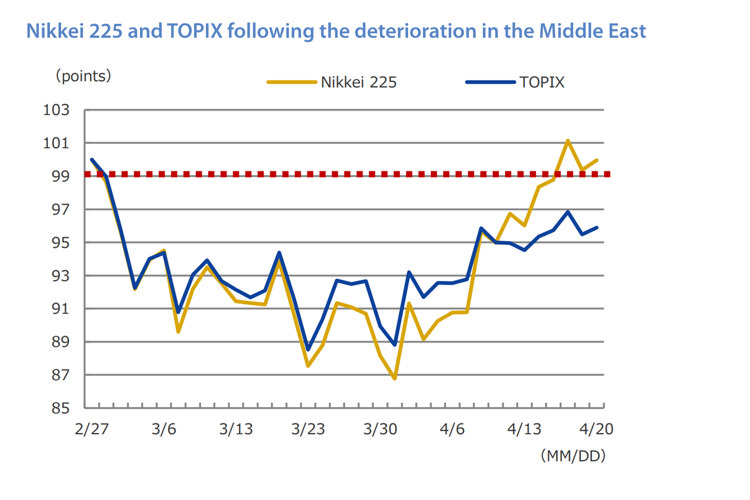
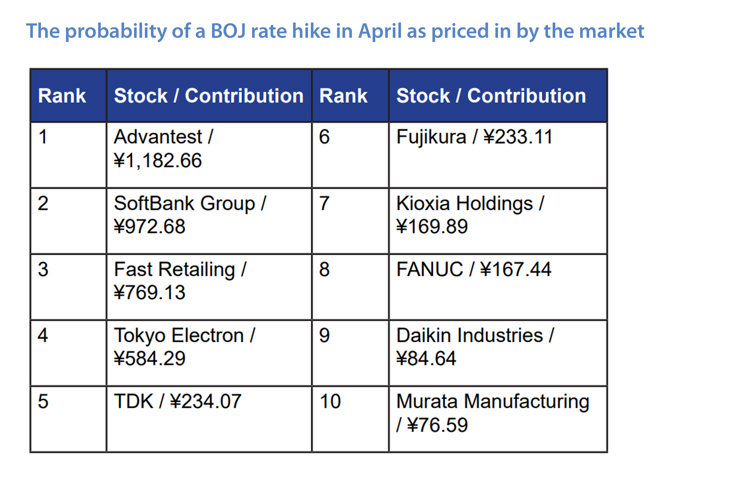
The Nikkei has risen sharply in recent days, but the main contributors have been high-priced stocks such as Advantest, SoftBank Group, and Tokyo Electron, which appear to have benefited from the rally in US tech shares. If the above scenario for the Middle East is being priced in to some extent, the sustainability of the rise in Japanese equities is increasingly likely to hinge on the earnings results of Japanese companies as well as U.S. tech firms that are scheduled to be released in the coming weeks.
Rates expected to remain unchanged
Lastly, the fact that global events have changed expectations for further monetary normalization in Japan is also relevant. The market-implied probability of a rate hike has declined, and the Bank of Japan (BoJ) is expected to leave rates unchanged this time; attention will be on the Outlook Report and Governor Ueda’s remarks.
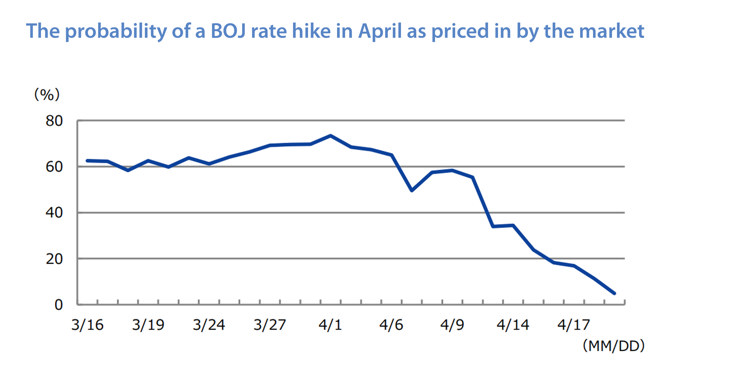
The BoJ will hold its Monetary Policy Meeting on April 27–28. The market-implied probability of a rate hike at this meeting briefly rose to around 70% in early April, but expectations have since retreated sharply, as the BOJ has not communicated anything suggesting an imminent hike. Accordingly, we have revised our forecast for the next rate hike to June, and raised our terminal rate assumption from 1.75% to 2.00%. Broadly speaking, this is supportive for the equity market and the stability of the monetary environment is a further factor aiding the market rebound.
Note: Although individual stocks are mentioned, this does not constitute a recommendation of those securities.

Oskar Alexander POTYKA, CFA
Director of Business Development
MARKETING COMMUNICATION FOR PROFESSIONAL INVESTORS ONLY – 10/03/2026
General This is a marketing communication. Please refer to the prospectus of SMD-AM UCITS Fund (the “Fund”), and the Key Information Document (“KID”) for the relevant sub-fund before making any final investment decision. Investors should also take into account all of the relevant sub-fund’s characteristics and objectives as described in the prospectus and other fund documentation before investing. Financial information on the Fund is provided in the latest audited annual report or interim, whichever is newest. The KID, the prospectus, the articles of incorporation and the most recent annual report and the latest semi-annual report, if published thereafter, are the only binding basis for the purchase of shares and investment decisions should be based solely on this. These documents can be obtained free of charge at Sumitomo Mitsui DS Asset Management (Deutschland) GmbH, and on https://www.smd-am.co.uk/fund-centre. The prospectus of the Fund is available in English and the KID is available in the official language of the countries in which the Fund is available for distribution. Please note that the prospectus is not available in French. This marketing communication is provided to you by Sumitomo Mitsui DS Asset Management (Deutschland) GmbH. Sumitomo Mitsui DS Asset Management (Deutschland) GmbH is a limited liability company incorporated in Germany under the company registration number HRB 141563, with registered office at Neue Mainzer Straße 52-58, 60311 Frankfurt am Main, Germany. For the avoidance of doubt, Sumitomo Mitsui DS Asset Management (Deutschland) GmbH acts exclusively for the account and under the liability of AHP Capital Management GmbH and is not itself authorised as an investment firm within the meaning given to this term by Directive 2014/65/EU of the European Parliament and of the Council of 15 May 2014 on markets in financial instruments and amending Directive 2002/92/EC and Directive 2011/61/EU (recast) (“MiFID II”). This marketing communication and any information contained herein is exclusively intended for use by and directed at individuals who are “professional clients” within the meaning given to this term by MiFID II. No Offer; no Invitation to Buy - This marketing communication does not constitute advice, or a personal recommendation to buy, sell, hold or otherwise transact in the Fund, securities or other specific investment products. The prices and valuations shown are non-binding and, like other included information, are for informative purposes only. You should read the KID, the prospectus and the last half / annual report and contact a professional adviser for personalised advice before making any investment decision. No Investment Advice; No Investment Recommendation or Investment Strategy Recommendation -The information contained in this marketing communication does not represent investment advice within the meaning of Article 4(1) (4) MiFID II or any other recommendation to buy securities or products within the meaning of Article 3(1)(34) of Regulation (EU) No 596/2014 or investment recommendations within the meaning of Article 3(1)(35) of Regulation (EU) No 596/2014. Risk Warning - You should be aware that there are significant risks associated with the Fund. The complete information on the Funds or respective sub-fund’s risks can be found in the prospectus and the KID, which are available as described above. An investment should not be contemplated until the risks are fully considered. You are reminded that past performance should not be seen as an indication or a guarantee to future performance, and no representation or warranty, express or implied, is made regarding future performance. Investment in any financial instrument and/or designated investment involves risks, including the potential loss of the entire amount you have invested. Investor Rights - A summary of investor rights is available free of charge in English at the following link: https://www.vistra.com/sites/default/files/2024-05/summary-of-investor-rights-luxembourg-klmc.pdf. The management company of the Fund may decide to terminate the arrangements made for the marketing of the respective sub-fund in any jurisdiction. Additional Information for US Citizens - For the avoidance of doubt, the information contained in this document and the Fund presented herein are not intended for distribution in the United States of America or to US persons (i. e. individuals that are either citizens or residents of the United States of America and / or are subject to US taxation as well as partnerships or corporations that have been incorporated under the laws of the USA, a US State, US territory or US possession). Shares in the Fund are therefore neither offered nor sold in the United States of America or to or on the account of US persons. Any subsequent transfer of investment fund units into the United States of America or to US persons is not permitted. Sustainability Related Disclosures - The sub-funds of the Fund are making the following disclosures under Regulation (EU) 2019/2088 (Sustainable Finance Disclosure Regulation - “SFDR”): Detailed sustainability-related disclosures for the Fund, as required by SFDR, are available for all Sub-Funds at www.smd-am.co.uk/sustainability/. Investors should note that, relative to the expectations of the Autorité des Marchés Financiers in France, the Fund presents disproportionate communication on the consideration of non-financial criteria in its management. Management Company: Paying Agents: Contact Details Sumitomo Mitsui DS Asset Management (Deutschland) GmbH |

 United Kingdom
 Switzerland
 Luxembourg
 Germany
 Finland
 Ireland
 Netherlands
 Rest of EEA
 Middle East
 Japan 日本
 Hong Kong 香港
 Singapore 新加坡
 USA
USA
 Other
Other